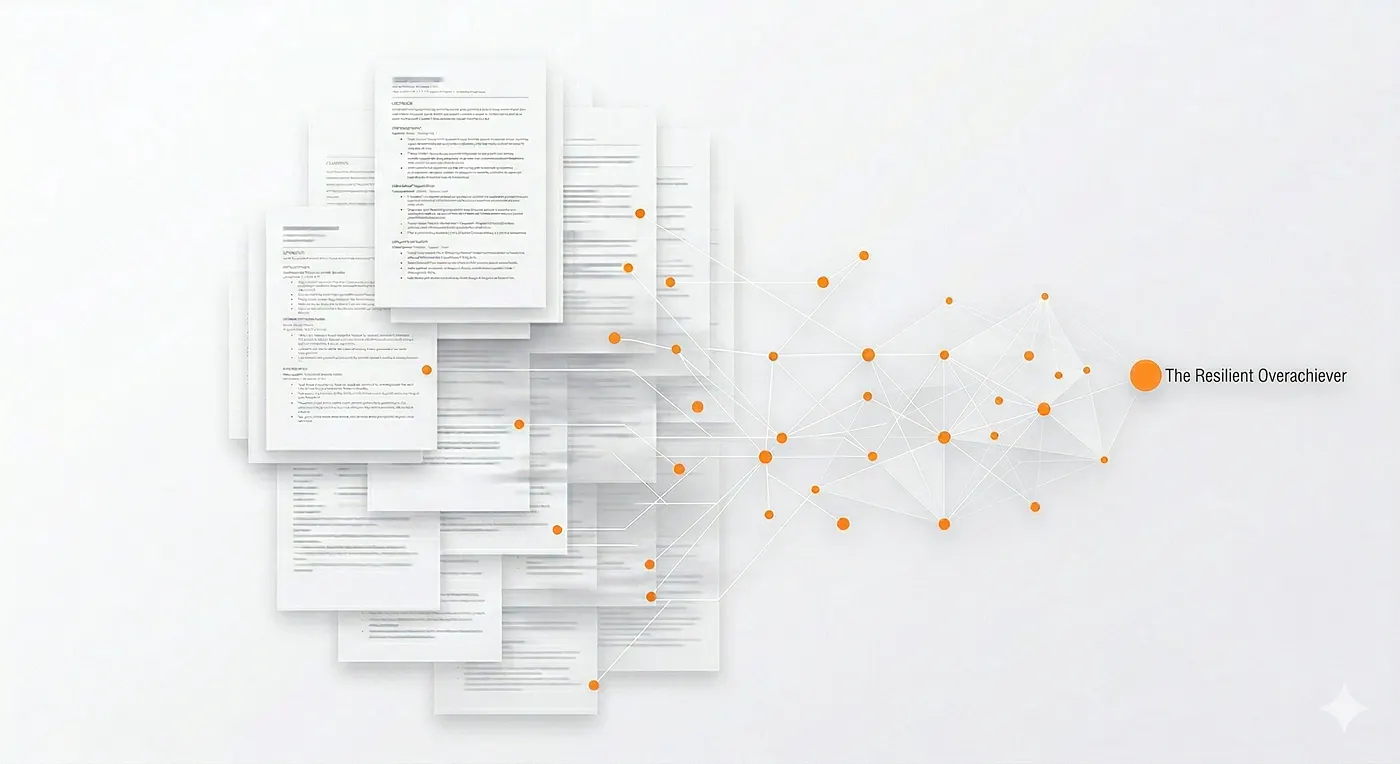
If companies use ATS to filter resumes by keywords, more and more candidates will use AI to optimize for those keywords.
That’s not a hack. That’s automation and adaptation.
In order to escalate the automation on the applicant’s side, I built CV Superstar an AI native Chrome extension designed to save time and help land more interviews by automatically customising the CV for every job posting.
But building it and thinking about it in depth, forced me to see a 2nd-order effect I initially missed. Tools like this are likely part of a transitional problem.
AI doesn’t just improve resumes. It standardizes them. It raises the floor and lowers the ceiling at the same time.
Before LLMs, customizing CVs was a matter of resilience or being picky. Now the same candidate can easily generate 100s of “perfect-fit” CVs for 100s of roles.
At scale:
- more candidates can pass filters
- more profiles look identical
- differentiation collapses
This isn’t the first time hiring has shifted.
Before the internet, companies competed for talent the way you’d expect in a constrained market, slowly, strategically, through networks and reputation. Access was limited, which meant signal was high.
The LinkedIn era democratized access. Suddenly companies could filter, sort, and choose from a massive pool. Volume replaced scarcity for the majority of hiring. The top of the funnel became a ranking problem.
Now, in the “early” AI/LLM era, the ranking problem is becoming a noise problem. Polished CVs, hours of careful thinking, years of high-quality output, all of it flattened into tokens. The outlier professional has never been harder to spot.
That friend who kept procrastinating on their CV? They weren’t behind. They were early.
If there’s no going back, what replaces the resume?
Nothing singular. A shift from static documents to dynamic systems of proof. Instead of a self-reported snapshot, tech hiring will increasingly rely on continuously updated, externally verifiable signals.
I see us daily getting closer to the scenario of having agents aggregating proof of work across the internet:
- things you’ve built
- things you’ve written
- how you think, over time
- signals from platforms like X
And that’s where resilience, taste, and high-quality work start to win again, after the noise, despite the networks.